
When people search for “diamond quality factors explained,” they want a clear, simple breakdown of what really makes one diamond better (and more expensive) than another. The key quality pillars are known as the 4Cs—cut, color, clarity, and carat—plus an independent grading certification that proves what you are buying. Together, these factors shape how brilliant, white, clean, and valuable a diamond looks in real life.
In practice, understanding the 4Cs helps you avoid overpaying for things you cannot see, and instead focus on the visible beauty of the stone. By learning how to read a diamond clarity chart, how to interpret diamond color grades, and what a grading report actually verifies, you can balance budget and sparkle with confidence. This guide breaks everything into simple Q&A so you can skim, compare, and make a smart decision fast.
How Do the 4Cs Work Together to Determine Diamond Quality?
The 4Cs—cut, color, clarity, and carat—are a standard system used worldwide to evaluate diamond quality. They were formalized by the Gemological Institute of America (GIA) and adopted by leading labs and jewelers, which is why you see them in almost every diamond listing.
Each “C” measures a different aspect of a diamond:
- Cut: How well the diamond has been shaped and proportioned.
- Color: How white or tinted (usually yellow or brown) the diamond appears.
- Clarity: How many internal or external flaws the diamond has.
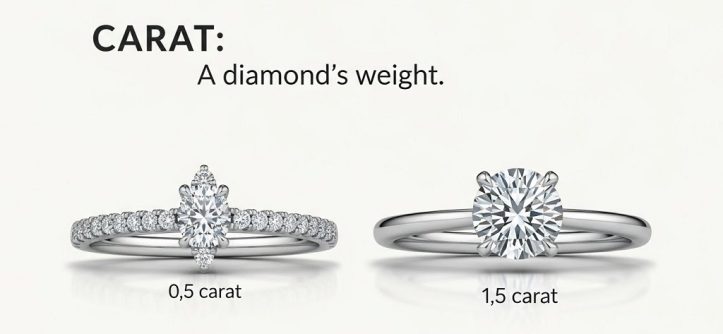
- Carat weight: How heavy (and therefore usually how large) the diamond is.
The magic happens when you understand that the 4Cs are not equal. Cut has the biggest impact on sparkle. Color and clarity can often be traded down slightly to save money without losing beauty, as long as the cut is strong and the diamond is eye-clean and face-up white in your chosen setting.
Why Is Diamond Cut the Most Important Quality Factor?
Diamond cut is the most powerful of all the quality factors because it controls how much light the diamond reflects back to your eye. A well-cut diamond looks lively, bright, and fiery, even if its color and clarity are not perfect on paper.
Cut is not the same as shape. Shape is the outline (round, oval, princess, cushion, emerald, etc.). Cut describes how precisely the facets are arranged, their angles, symmetry, and polish. A diamond with excellent cut proportions will:
- Maximize brilliance (white light return).
- Show strong fire (colored flashes).
- Display attractive scintillation (sparkle when the diamond moves).
On the flip side, a poorly cut stone can look dull, glassy, or “sleepy,” even if it’s large and technically high in color and clarity. That’s why a smart strategy is to prioritize Excellent/Ideal cut grades over chasing the very top clarity or color grades that are hard to see with the naked eye.
What Cut Grades Should You Look For?
For round brilliant diamonds, top labs typically grade cut on a scale like Excellent, Very Good, Good, Fair, and Poor. For the best sparkle and long-term value, aim for:
- Excellent or Ideal cut for round diamonds.
- Very Good at minimum if your budget is tight.
Fancy shapes (oval, cushion, emerald, pear, etc.) are not always given an official cut grade, so you’ll rely more on proportions, videos, images, and expert recommendations. Regardless of shape, never trade away cut quality just to gain a little carat weight—it’s almost always a bad deal visually.
What Are Diamond Color Grades and How Do They Affect Appearance?
Diamond color grades describe how “colorless” or “tinted” a diamond is when viewed under controlled lighting. The standard scale used by GIA and similar labs runs from D (completely colorless) down to Z (noticeable yellow or brown tint).
Here is a simplified view of the most common diamond color grades:
| Color Grade | Color Description | Practical Notes |
|---|---|---|
| D–F | Colorless | Very bright and icy white; premium pricing. |
| G–H | Near-colorless | Excellent value; looks white in most settings. |
| I–J | Near-colorless with slight warmth | Often still white face-up, especially in yellow/rose gold. |
| K–M | Faint color | Light warmth visible; can be charming in vintage styles. |
How Should You Choose Diamond Color Grades?
What matters most is how the diamond looks when worn, not the letter on paper. In white metals (platinum and white gold), many buyers like to stay in the G–H range for a white, bright look without paying D–F prices. In yellow or rose gold, you can drop slightly lower—often to I–J—because the warm metal disguises much of the faint color.
Unless you’re extremely color-sensitive or buying an investment-level stone, going for the highest diamond color grades usually isn’t necessary. Instead, target a grade where the diamond looks white to your eye in your chosen setting, and allocate more budget to excellent cut and a larger, more impressive size.
What Is a Diamond Clarity Chart and How Do You Use It?
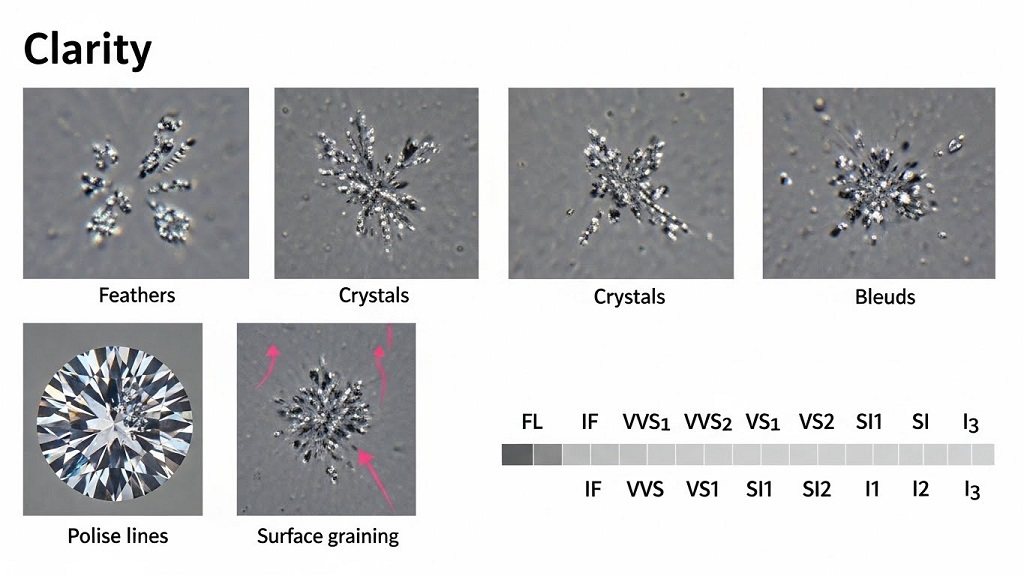
A diamond clarity chart is a visual or tabular guide that explains how labs classify internal and external imperfections in a diamond. These imperfections are called inclusions (internal) and blemishes (external). The standard clarity scale runs from “Flawless” at the top to “Included” at the bottom.
| Clarity Grade | Abbreviation | What It Means |
|---|---|---|
| Flawless | FL | No inclusions/blemishes visible under 10x magnification. |
| Internally Flawless | IF | No internal inclusions under 10x; tiny surface marks only. |
| Very Very Slightly Included | VVS1, VVS2 | Extremely tiny inclusions, very hard to see at 10x. |
| Very Slightly Included | VS1, VS2 | Minor inclusions, difficult to see at 10x. |
| Slightly Included | SI1, SI2 | Noticeable inclusions at 10x; often hard or impossible to see with the naked eye from normal viewing distance. |
| Included | I1, I2, I3 | Obvious inclusions that can affect appearance and durability. |
What Clarity Grade Is “Good Enough” for Most Buyers?
The trick with clarity is to aim for an “eye-clean” diamond rather than obsessing over microscopic perfection. Eye-clean means that you cannot see any inclusions with your naked eye from a normal viewing distance, even though they exist under magnification.
For many shapes, VS2 to SI1 often provides the best balance—especially if you view real photos or videos and confirm that the inclusions are small, white, or well hidden. Higher grades like VVS and IF are technically rarer, but the visual difference is negligible in everyday wear, so you’re mainly paying for bragging rights and collector value.
What Does Carat Actually Measure in Diamonds?
Carat is a unit of weight, not size. One carat equals 0.2 grams. However, because diamonds are three-dimensional, two stones with the same carat weight can look larger or smaller depending on how they’re cut.
Many shoppers fixate on “magic numbers” like 0.50 ct, 1.00 ct, 1.50 ct, and 2.00 ct, which are common psychological benchmarks. Diamonds just below these thresholds (for example, 0.90 ct instead of 1.00 ct) often look very similar in size but cost significantly less. This makes “just-shy” carat weights a powerful way to stretch your budget.
How Should You Prioritize Carat Versus the Other Cs?
Bigger isn’t better if the diamond is dull or visibly flawed. A smaller, well-cut diamond with balanced color and clarity often looks better—and more expensive—than a larger stone with poor cut or obvious inclusions.
Start by deciding your ideal carat range based on finger size, style, and budget. Then, protect cut quality first, keep color and clarity in a sensible “sweet spot” (for example, G–H color and VS2–SI1 clarity for many buyers), and finally look for the biggest stone that fits within those guidelines.
Why Is Certification So Important When Evaluating Diamond Quality?
Certification is the fifth pillar of diamond quality. A diamond grading report from a reputable lab is an independent confirmation of its cut, color, clarity, and carat weight. Without it, you are essentially taking the seller’s word for everything.
Well-known labs include GIA (Gemological Institute of America), AGS (American Gem Society, now integrated into GIA standards), and a few respected region-specific labs. These institutions use strict, consistent grading systems. Lower-tier or in-house “certificates” may use looser standards, meaning a diamond labeled “G color” on one report might be closer to an H or I on a top-tier report.
What Should You Look for in a Diamond Certificate?
A good grading report will include:
- Exact carat weight, color grade, and clarity grade.
- Cut grade for round brilliants, plus proportions and measurements.
- Details or a plot of inclusions and blemishes.
- Polish, symmetry, and fluorescence information.
- A unique report number that you can verify on the lab’s website.
Always cross-check the report number online to ensure the document is authentic and matches the stone you’re buying. For maximum reassurance, many buyers prefer diamonds graded by GIA or an equivalent top-tier laboratory.
How Can You Balance All Diamond Quality Factors for the Best Value?
Balancing quality and budget is where “diamond quality factors explained” becomes truly practical. The goal is not perfection in every category, but the best visible beauty for your money.
A common value-focused strategy for an engagement ring might look like this:
- Cut: Excellent/Ideal (non-negotiable).
- Color: G–H in white metals; I–J in yellow or rose gold to save more.
- Clarity: VS2–SI1, as long as the stone is eye-clean.
- Carat: Choose a weight that looks proportionate and fits budget, considering “just below” magic sizes.
- Certification: GIA or other top-tier lab for reliable grading and resale confidence.
This kind of balanced approach lets you own a diamond that looks bright, clean, and substantial in real life—even if its paper specs aren’t “perfect” on every line.
What Are the Most Common Mistakes People Make When Choosing Diamond Quality?
Several predictable mistakes cause buyers to overspend or end up with a dull-looking stone:
- Chasing the highest carat at the expense of cut quality.
- Paying a big premium for ultra-high clarity or color they can’t see.
- Ignoring certification or trusting vague in-store descriptions.
- Judging diamonds only from still images without videos or magnified views.
A more strategic approach is to define your priorities (size, sparkle, budget), understand the trade-offs between the 4Cs, and use tools like diamond clarity charts and real photos to verify that the stone looks great at normal viewing distance—not just in a lab report.
Conclusion: How Do You Use Diamond Quality Factors to Buy with Confidence?
Once you have the diamond quality factors explained clearly, you realize that buying a beautiful stone is less about memorizing jargon and more about smart trade-offs. Cut drives sparkle, color controls how white the diamond looks, clarity tells you how clean it appears, carat sets its presence on the finger, and certification confirms that all those details are trustworthy.
Instead of aiming for perfection in every C, focus on what you and the wearer will actually see day-to-day: brightness, size, and overall beauty. A well-balanced diamond with excellent cut, sensible color and clarity, and a comfortable carat weight almost always beats a technically “perfect” but budget-breaking stone.
If you are currently comparing diamonds, use this guide as a checklist. Shortlist a few stones, review their cut, diamond clarity chart positions, and diamond color grades, and then choose the one that offers the best mix of sparkle, size, and value. When you are ready, talk to a trusted jeweler or online retailer, ask to review certificates and images, and take the next step toward a diamond you will be proud to wear for life.
Call to Action: Bookmark this guide, keep it open while you shop, and use the 4Cs plus certification like a scorecard. When you find a diamond that checks all the right boxes, act with confidence—you will be making a well-informed, value-smart investment in a piece you will enjoy every single day.
Related Topics: How to Create File Management For Your Team
FAQ: Diamond Quality Factors Explained
What are the 4Cs of diamond quality?
The 4Cs are cut, color, clarity, and carat weight. They are the globally recognized system used to describe and compare diamond quality, and they directly impact beauty and price.
Which diamond quality factor is most important?
Cut is the most important quality factor because it determines how much a diamond sparkles. Even with good color and clarity, a poor cut can make a stone look dull and lifeless.
What is a good clarity grade for an engagement ring?
For most buyers, a clarity grade around VS2–SI1 offers excellent value. These grades are often eye-clean, meaning you don’t see inclusions without magnification, but you avoid the heavy premiums of VVS and Flawless stones.
Which diamond color grades should I choose?
In white metal settings, G–H color usually looks bright and white without the high price of D–F. In yellow or rose gold, I–J can still appear visually white and provide additional savings.
Do I really need a certified diamond?
Yes. A diamond grading report from a respected lab verifies the 4Cs and protects you from overpaying. Certification is essential for transparency, fair pricing, and future resale or upgrading.
Is a bigger carat weight always better?
No. A smaller diamond with excellent cut and balanced color and clarity can look better than a larger stone with poor cut or visible flaws. Bigger is only better when overall quality is still strong.
How do I use a diamond clarity chart when shopping online?
Use a diamond clarity chart to understand what each grade means, then check photos, videos, and grading plots to confirm whether a specific stone is eye-clean. Prioritize how it looks in real-life viewing over the grade name alone.




Leave a Reply